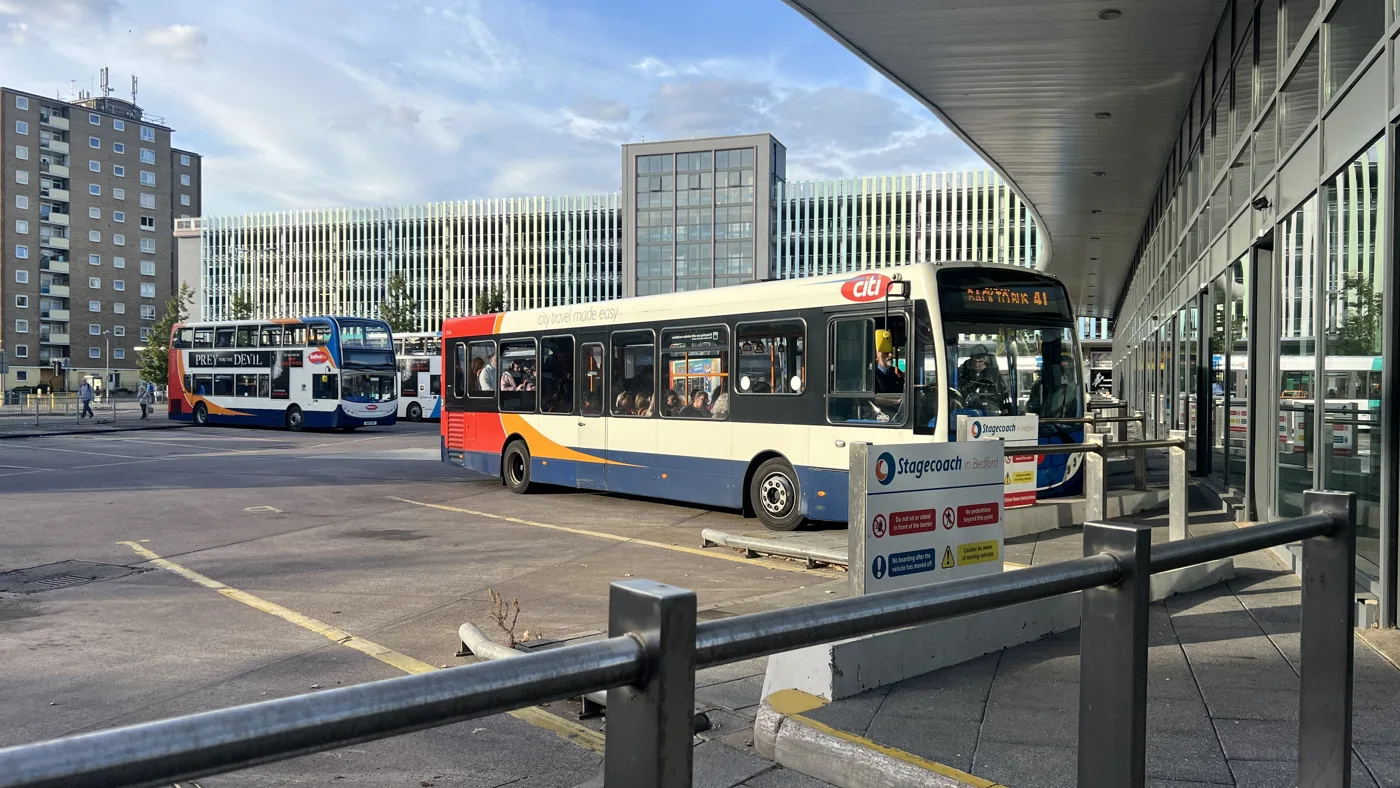

The council has agreed funding for an hourly bus, 7.30am to 7.30pm Monday to Saturday, covering both hospitals, the station and Kempston. No route number yet.
Bedford Borough Council has agreed to pay for a bus service of its own. At its meeting on 16 September, the Executive agreed to reallocate grant funding to commission what its report calls “a package of contracted bus services”, on a two-year, one-plus-one basis, after a run of commercial routes were withdrawn across the borough.
The record of decisions, published on 18 September, puts it in one sentence: that the reallocation “be agreed”, subject to the services “being financially affordable within the available funding envelope”.
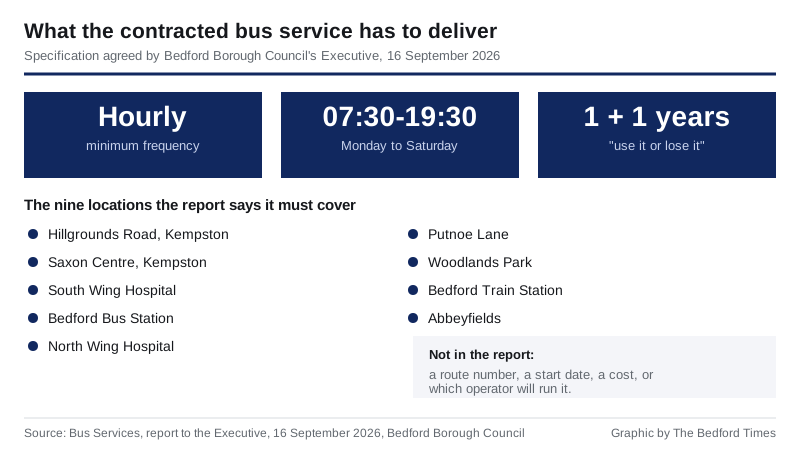
The spec is the part worth reading. The report to the Executive sets out what the commissioned service has to deliver:
- a minimum hourly frequency
- 07:30 to 19:30, Monday to Saturday
- coverage of nine named locations
Those locations, in the order the report lists them, are Hillgrounds Road, the Saxon Centre, South Wing Hospital, Bedford Bus Station, North Wing Hospital, Putnoe Lane, Woodlands Park, Bedford Train Station and Abbeyfields. Hillgrounds Road and the Saxon Centre are both in Kempston.
That is a route linking the two ends of the borough’s hospital estate with the bus station and the railway station, which is exactly the gap residents without a car have been describing since the commercial withdrawals began.
What the council has not said
Quite a lot, and it is worth being plain about it.
- No route number and no map. The report names locations, not a line on a map, and does not say in which order the bus will serve them.
- No start date. Nothing in the report or the decision says when the service begins.
- No cost. The word “reallocating” is doing heavy lifting. The report gives no figure for the funding being moved, no figure for what the contract is worth, and no indication of what the money was previously earmarked for.
- No operator. The report names Grant Palmer, Stagecoach East and Uno as the operators the council has been meeting, but does not say which of them, if any, will run this.
“Use it or lose it”
The council has been explicit that the service is on probation. Its report sets out the terms:
- performance-based operation, with reliability, punctuality and customer experience monitored regularly
- passenger usage monitoring throughout the contract, “to ensure services remain justified”
- value-for-money controls, with funding allocated only where a service shows “ongoing social necessity and financial viability”
- flexibility to adjust or withdraw: under the use-it-or-lose-it model, “services may be revised or discontinued if usage does not reach sustainable levels”
- a two-year commissioning window, structured as one year plus one
In other words, if the buses run empty in year one, there may not be a year two. That is stated in the council’s own paper rather than inferred from it.
Why the council is doing this rather than ordering operators to
Because it cannot order them. The report is unusually direct on the point, and it is the single most useful thing in the document for anyone who has written to the council about a lost bus.
Under the Transport Act 1985, commercial operators keep “full autonomy over routes, timetables, fares and service levels”. The council’s paper says that directly requiring an operator to run a particular route or frequency “would be unlawful and unenforceable”, and that any attempt to do so would be ultra vires. Its officers rejected that option outright.
They also rejected the other obvious one: using council money to reinstate every withdrawn or reduced service. The stated reason is that the recurring revenue cost “would be unsustainable”, which lands differently in a borough forecasting a £3.647m overspend this year.
Where this came from
Full Council passed three motions on bus services on 1 July 2026. Between them they told the Executive to liaise with operators on a network that serves residents “not just their commercial gain”, to find replacement services where routes had been lost, to work with schools and colleges on getting pupils back onto public transport, to publish what the Bus Service Improvement Plan money had been spent on, and to consult ward councillors before changes are made.
The 16 September report is the Executive’s answer to all five. On the ones that can be checked, the answers are mixed:
- Replacement services: the council claims one concrete win, the “reinstatement of connectivity between Bromham, Wootton and Bedford”.
- Schools and colleges: discussions have started with schools, academies and Bedford College, and a joint working group is “being established” for the 2026/27 academic year. Nothing has changed yet.
- BSIP transparency: a detailed breakdown of allocations and spend has been given to members of the Environment and Sustainable Communities scrutiny committee. Officers are “working on publishing further information on the Council’s website”. It is not published yet, which is the specific thing the motion asked for.
- Ward councillor engagement: a new protocol has been introduced, with early notification of operator proposals.
The Executive also agreed to set up a Members’ Bus Forum, which the Environment and Sustainable Communities Overview and Scrutiny Committee had asked for on 16 July after hearing from the operators directly. Nominations have been sought from two councillors each from the Labour, Liberal Democrat and Conservative groups, and one each from the Green and Independent groups. No first meeting date has been set.
The report’s own risk section is candid about what might still go wrong: replacement services “may be unaffordable or operationally constrained, creating expectations that cannot always be met”, and driver shortages and rising operating costs “continue to affect network stability”.
What it means for you
If you use the bus in Bedford or Kempston, three things follow.
Nothing changes yet. There is no start date, no route number and no timetable. The decision agrees the money can be moved; it does not put a bus on the road.
When it does start, use it. The use-it-or-lose-it structure means passenger numbers in the first year decide whether there is a second. The council has said it will monitor usage data throughout.
The decision can still be called in. The deadline for any four or more councillors to call in the decisions from the 16 September Executive is Tuesday 23 September 2026. Decisions not called in are implemented after that.
If you want the detail on what the BSIP money has funded so far, that breakdown has gone to the Environment and Sustainable Communities Overview and Scrutiny Committee but is not on the council’s website. Papers for that committee are published on the council’s democracy portal.
Our other Bedford Borough Council coverage is on the Bedford planning page, and current road closures, including the Greyfriars works that pause the Bus Station Hub stops next month, are on the roadworks and travel page.
Sources
- Record of decisions, Executive, 16 September 2026, Bedford Borough Council, published 18 September 2026
- Bus Services: report to the Executive, 16 September 2026, Portfolio Holder for Environment and Interim Strategic Director (Environment)
- Reference on bus services from the Environment and Sustainable Communities Overview and Scrutiny Committee, 16 July 2026
- Agenda and decisions, Executive, 16 September 2026, Bedford Borough Council
Have your say