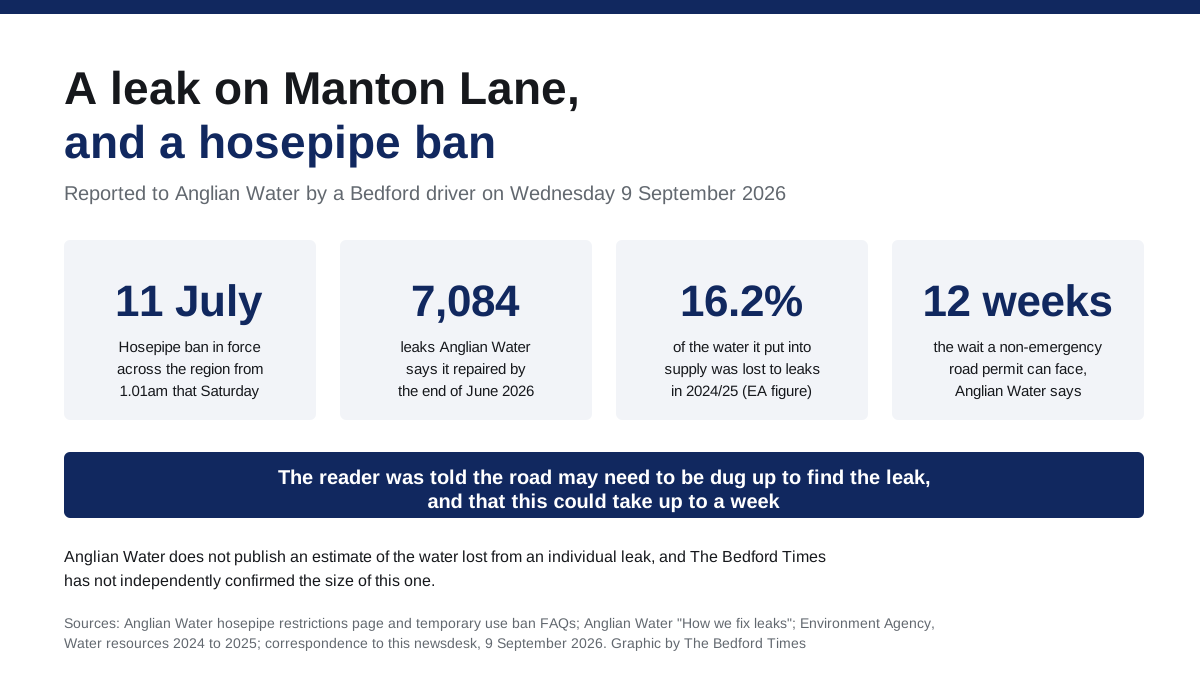
A Bedford driver reported a large leak on Manton Lane on Wednesday and was told the road may need digging up. Anglian Water's hosepipe ban began on 11 July.
A Bedford driver reported a large water leak on Manton Lane to Anglian Water on Wednesday, and was told the road may have to be dug up before the exact source can be found. They were told the work could take up to a week.
The reader contacted this newsdesk the same evening. Anglian Water sent an engineer to the site quickly, they said, and the engineer later rang them back to explain what would happen next.
Manton Lane runs across the north of the town, between Clapham Road and the Brickhill and Manton Heights area, in the MK41 postcode district of Bedford borough.
The region has been under a hosepipe ban since 1.01am on Saturday 11 July. That is the part the reader wanted looked at.
What the reader told us
We are quoting their account at length, because their words are the point of the story. They wrote:
“Today I was driving along Manton Lane in Bedford when I noticed an enormous amount of water gushing from what appeared to be a serious water leak. I immediately reported it to the water company, and I have to say that they responded very quickly and sent an engineer to the site.”
“The engineer subsequently contacted me and explained that they have identified the problem but that they need to dig up the road to locate exactly where the leak is. I was told that this could take up to a week.”
“My concern is that, in the meantime, a huge amount of treated drinking water appears to be continuing to escape into the road and drainage system.”
They were careful to separate the response from the outcome:
“I completely appreciate that finding and repairing an underground leak can take time, and I am not criticising the engineer who attended, in fact, I was impressed with how quickly they responded to my report. But surely the fact that such a substantial amount of water is potentially being lost for several days while residents are being asked to conserve water is something the public should know about.”
They asked three things: how much water is estimated to be escaping, whether anything can be done to slow the flow while the investigation goes on, and whether the water company thinks a leak of that size running for days is acceptable.
What we could and could not confirm
We can confirm the hosepipe ban and everything below about how Anglian Water says it handles leaks, because the company publishes all of it.
We have not independently confirmed the size of this leak, how long it has been running, or the repair timetable the engineer gave. That account is the reader’s, and we report it as theirs.
Anglian Water does not publish an estimate of the water lost from an individual leak, so the reader’s first question has no published answer. Its figures are given at company level, and those are set out further down.
Why a leak can sit in the road for days
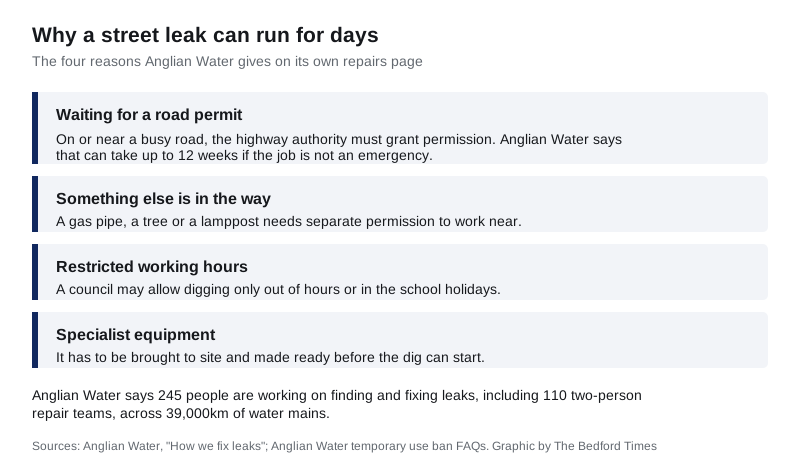
Anglian Water’s own repairs page is unusually frank about this. It says it will fix leaks as quickly as it can, then lists the reasons it often cannot:
- The permit. If the leak is on or near a busy road, the highway authority has to grant permission before anyone digs. Anglian Water says that “if it’s not an emergency this can take them up to 12 weeks to grant”.
- Other services in the ground. A gas pipe, a tree or a lamppost in the way needs separate permission to work near.
- Restricted hours. A council may only allow the work out of hours or in the school holidays, to keep traffic moving.
- Kit. Specialist equipment has to be brought to site and set up.
The company also explains the blue paint residents sometimes see appear before a dig. The technician who inspects a leak sprays the area blue so the repair crew knows where to break the surface. It says the paint is not permanent and fades over time.
Not every reported leak turns out to be one. Anglian Water says inspections sometimes find a natural spring, or a leak on a private supply pipe, in which case it tells the owner and asks them to fix it. (Anglian Water, How we fix leaks)
The company’s own leakage numbers
Anglian Water publishes these in its answers on the hosepipe ban:
- 245 people are working on finding and fixing leaks, including 110 two-person repair teams, with what it calls increased 24/7 response cover.
- By the end of June 2026 it had repaired 7,084 leaks this year.
- It uses more than 130,000 acoustic leak sensors a year, plus satellites, drones and leak detection dogs.
- Its network is 39,000km of water mains, some of it decades old.
- It says the region’s clay-rich soils shrink in dry weather and swell when wet, and that this movement puts extra pressure on buried pipes and causes more bursts.
(Anglian Water, temporary use ban FAQs)
The independent measure comes from the Environment Agency, which publishes every company’s leakage each year. For 2024 to 2025 it recorded Anglian Water losing 16.2 per cent of the water it put into supply, against an England and Wales average of 18.8 per cent, and 80.93 litres per property per day against a national average of 101.68. (Environment Agency, Water resources 2024 to 2025)
So Bedford’s supplier loses less than most. It still loses about one litre in six.
Anglian Water’s answer to the reader’s question
The company has published a direct response to exactly the objection the reader raised. Under the heading “Why is there a hosepipe ban in place when so much water is lost through leaks?”, it says:
“It’s not a choice between fixing leaks or asking customers to save water, we need to do both.”
It then makes the arithmetic argument:
“The biggest challenge right now is exceptionally high water use during hot, dry weather. On the hottest days this year, demand increased by almost 400 million litres a day. Even if every leak could be found and fixed immediately, it still wouldn’t offset the extra water being used during these peak periods.”
Readers can judge that for themselves. It is the company’s case, published on its own site, and it does not address what happens to a single large leak in a single street while a permit is arranged.
Where the hosepipe ban stands
The ban is a temporary use ban, made under section 76 of the Water Industry Act 1991. It has applied to every Anglian Water customer except those in Hartlepool since 1.01am on Saturday 11 July 2026, and it is still in force.
Anglian Water says water use fell by around 9 per cent when the restrictions came in and has stayed around 5 per cent below normal since. It says most of its region remains in drought after a spring that brought 39 per cent of expected rainfall, followed by three heatwaves.
What you cannot do with a hosepipe, sprinkler or pressure washer connected to the mains includes watering the garden, washing the car, cleaning windows, filling paddling pools, swimming pools or hot tubs, filling ponds and ornamental fountains, and cleaning private leisure boats.
What you can still do:
- water the garden and grow fruit and vegetables with a watering can, a bucket or water from a water butt
- use a drip or trickle irrigation system, if it has a pressure reducing valve and delivers water to the soil or the plant roots
- use water as normal inside your home
Anglian Water says the average hosepipe uses at least 15 to 17 litres a minute, and up to 900 litres an hour. The average customer in the region uses around 120 litres a day.
Some customers and activities are exempt automatically, with no need to apply. That covers people on the Priority Services Register who cannot safely use a watering can for health reasons, and a set of statutory exceptions including business and commercial uses and newly planted trees, hedges and saplings. (Anglian Water, hosepipe restrictions)
There is no end date. The company says the restrictions stay “until water resources recover and we’re confident supplies have returned to more normal levels”.
What it means for you
If you see water running in the road, report it. Anglian Water asks people to check its In Your Area map first, in case the leak is already logged, then report it. The free 24/7 leakline is 0800 771 881, and there is an online form. (Anglian Water, Report a leak)
Say exactly where it is. The company’s whole process starts with a technician finding the leak on the ground, so a road name and a landmark matter more than a general area.
A leak on your own property is usually yours to fix. Anglian Water will put the bill on hold while you do, and metered customers can claim a one-off domestic leakage allowance once the repair is done.
Expect the road, not just the pipe. If a dig is needed on Manton Lane, that means barriers, signs and possibly temporary lights or a diversion. We track live closures on our Bedford roadworks and travel page.
The ban still applies while a leak is running. Contravening a temporary use ban is an offence, punishable on summary conviction by a fine not exceeding level 3 on the standard scale. (Water Industry Act 1991, section 76(5)) Anglian Water publishes an enforcement policy alongside the restrictions.
Tell us what you have seen
If you use Manton Lane and can say when the water first appeared, or when the repair crew arrives, we would like to know. Our tip line is on the got a story page. We will update this piece as the work progresses.
This story came to us from a reader. That is how the best local stories usually arrive.
Have your say