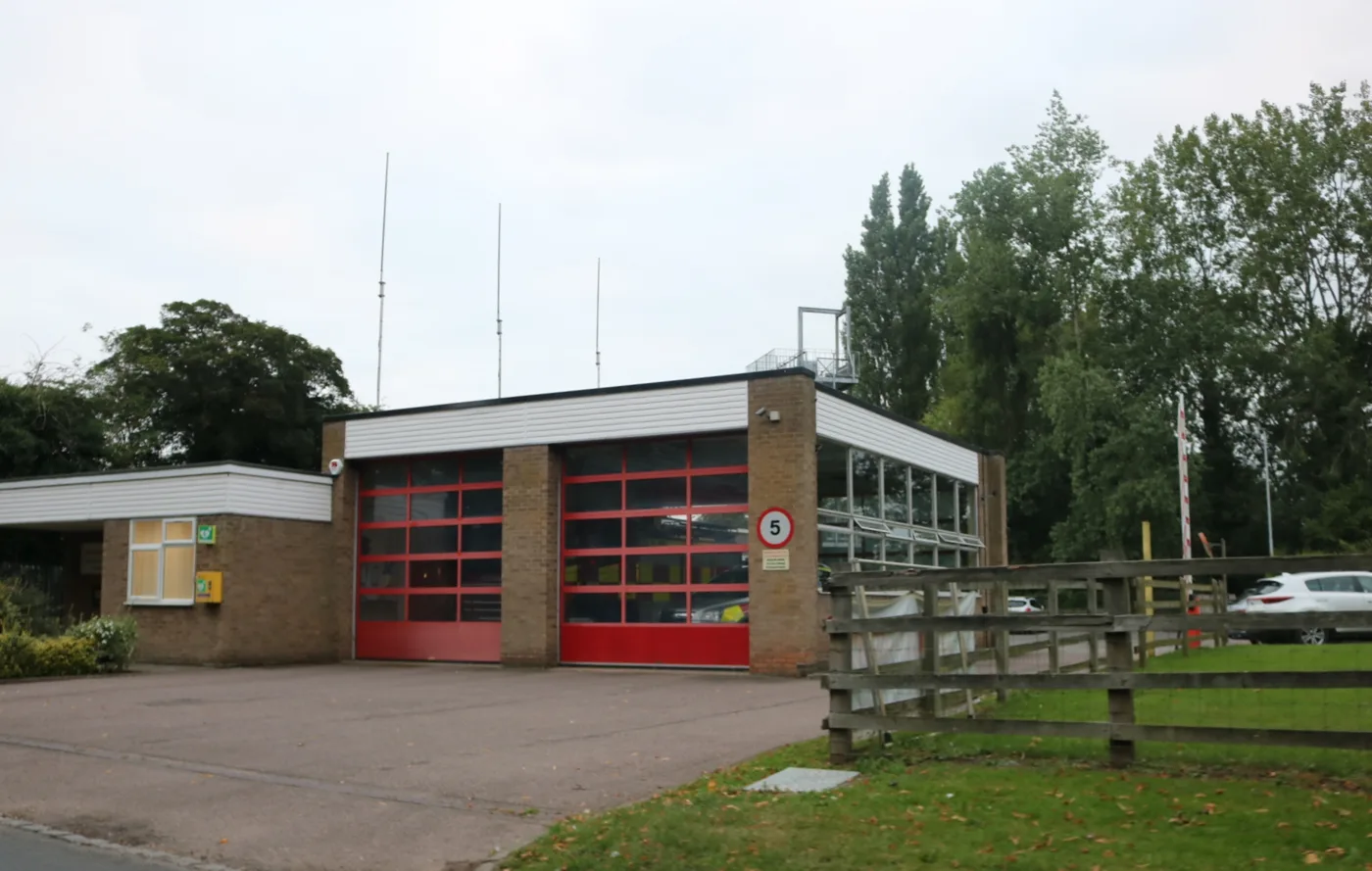

House fires near Harrold wait 16 minutes 50 seconds on average for a fire engine, the slowest in Bedfordshire. Comment on the fire service plan by 15 January.
A fire engine takes an average of 16 minutes 50 seconds to reach a house fire in the area served by Harrold fire station. That is the slowest of any station in Bedfordshire. In the fastest urban areas it is under eight minutes.
The figures are in the evidence behind Bedfordshire Fire and Rescue Service’s draft plan for 2027 to 2032. The service opened a 12-week public consultation on the plan on Friday 23 October. It closes on Friday 15 January 2027 at 11.59pm.
Harrold is a village about nine miles north-west of Bedford, near the Northamptonshire border. Its station covers villages across the north of the borough.
What the risk analysis found
The service’s Community Risk Analysis runs to 287 pages. It looks at every type of incident the service attends. The findings that matter most in and around Bedford:
- Rural reach is the weak point. House-fire attendance runs at 14 to 18 minutes at the rural stations serving Central Bedfordshire and the north of Bedford borough, against about 8 minutes in Luton and Bedford.
- The people most at risk live where help is slowest. The analysis says older, less mobile residents are concentrated “in precisely the dispersed areas where attendance is slowest”.
- Bedford is busy. The Bedford and Kempston station areas together account for 26.9% of fires in non-domestic buildings such as shops, sheds and farm buildings, second only to Luton’s 24.6%.
- House fires are down but have stopped falling. Recorded house fires across the county fell from 452 in 2018-19 to 321 in 2025-26, a 29% drop. Since 2021-22 they have levelled out at about 310 to 345 a year.
- Overall response is quicker. The county’s mean response time has improved from 10.6 minutes in 2018-19 to 9.9 minutes in 2025-26.
The service is clear that slow rural times are not poor performance. It calls the gap “structural”. Harrold, Woburn and Potton are single-engine stations covering “very large, sparsely populated catchments”, it says, so urban times are “unachievable by design rather than by shortfall”.
Care homes, hotels and hostels
The gap is widest for fires where people sleep but which are not homes: care homes, hotels, hostels and the prison.
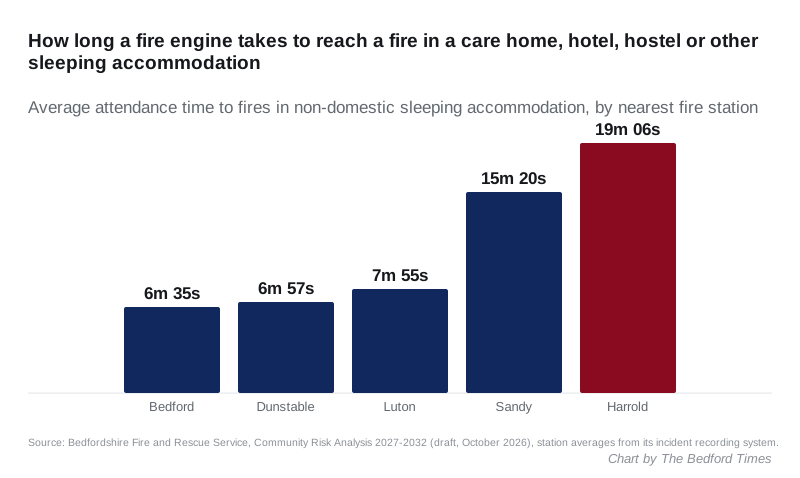
Average attendance at these fires is about 6 minutes 35 seconds from Bedford, 6 minutes 57 seconds from Dunstable and 7 minutes 55 seconds from Luton. It rises to 15 minutes 20 seconds at Sandy and 19 minutes 6 seconds at Harrold.
The Bedford station area recorded 229 of the county’s 379 fires of this kind, or 60%. That figure is skewed by HMP Bedford. The analysis says the prison estate generates around 45% of all incidents in the category.
The service says this creates “an inversion”. Much of the county’s care, nursing and sheltered accommodation is in rural areas, where the people inside are least able to escape unaided and the response is slowest.
Universal and the new towns
The analysis lists the big projects that will change the risks the service faces in the plan period. Two are in or next to Bedford borough:
- Universal’s resort at Kempston Hardwick and Stewartby, due to open in 2031. The service expects about 8.5 million visitors a year and calls it a “major new non-residential hazard” because of large crowds, complex buildings and heavy traffic.
- The proposed new town at Tempsford, up to 40,000 homes around a new East West Rail station, which we covered in our report on the Lords committee’s verdict on new towns.
It also points to the population getting older. The number of Bedford borough residents aged 85 and over is forecast to rise by 105% by 2043.
Chief Fire Officer Andy Hopkinson said in the service’s announcement: “Our county will experience huge change over the coming years and with this will come significant risks that we must be prepared for.”
What the plan proposes
The draft plan itself is short and general. It sets out four “pillars”:
- prevention, preparedness and community resilience
- understanding risk and aligning resources
- a high-performing and inclusive culture
- a flexible and future-ready service
Apart from delivering a replacement Luton fire station, it does not name any station to close, open or move, or any change to the number of fire engines. The risk analysis says the plan “should consider” whether engine positions, response standards and on-call availability match where the worst fires happen, rather than where fires are most frequent. The draft does not yet say what the answer is.
What it means for you
- You can have your say until 15 January. The anonymous survey is open to anyone who lives, works or studies in Bedfordshire. Questions can go to consultation@bedsfire.gov.uk.
- If you live in a village in the north of the borough, the service’s own figures show help takes longer to reach you. A working smoke alarm on every floor matters more here than anywhere.
- If you look after an older relative who lives alone, the service offers home fire safety visits, and the analysis says these residents are now where most of the remaining risk lies.
Sources
- Have your say on our Community Risk Management Plan 2027-32, Bedfordshire Fire and Rescue Service, 23 October 2026
- Public consultation page, Bedfordshire Fire and Rescue Service
- Draft Community Risk Management Plan 2027-2032
- Community Risk Analysis 2027-2032
Have your say