
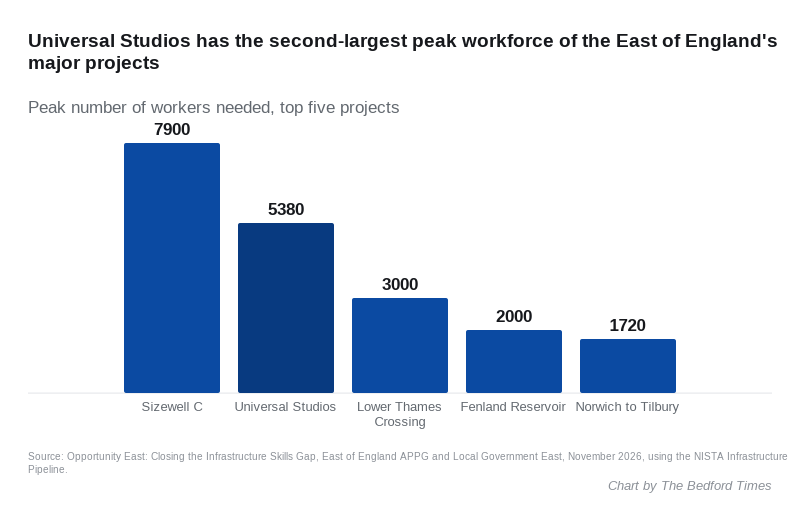
Universal Studios will need up to 5,380 workers at its 2029 peak, a report from MPs and councils says, as 57 East of England projects chase the same trades.
Universal Studios UK will need up to 5,380 workers at its peak in 2029, the second-largest workforce of any major project in the East of England, according to a report launched at the House of Lords on Tuesday 24 November.
The report, Opportunity East: Closing the Infrastructure Skills Gap, was produced by the East of England All-Party Parliamentary Group and Local Government East, which represents councils across the region. It warns that the region’s 57 Nationally Significant Infrastructure Projects, the most of any English region, will need up to 30,080 workers over the next five years, and that too few local people are being trained to fill those jobs.
Overview
- Up to 30,080 workers are needed over the next five years across the East of England’s 57 nationally significant projects, the report says, using the National Infrastructure Pipeline.
- Universal Studios needs up to 5,380 at its peak, second only to Sizewell C on 7,900.
- The report names the proposed new town at Tempsford, which it says will bring 40,000 new homes to Bedfordshire, as adding further demand for the same trades.
- About 90,000 young people in the region, 11.7% of 16 to 24 year olds, are not in education, employment or training.
- Dan Tomlinson MP, Minister for Growth, is the keynote speaker at the launch.
Why 2028 to 2030 matters
The report says activity peaks between 2028 and 2030, when Sealink, the Norwich to Tilbury electricity transmission line, the Lower Thames Crossing, Sizewell C and Universal Studios all overlap. Sizewell C is expected to reach its peak in 2030 and Universal Studios in 2029.
“This period of overlap is particularly important because many of these projects require similar occupations including civil engineers, project managers, plant operatives, electricians, steel fixers, quantity surveyors and construction managers,” the report says. It adds that it “can take four and a half years to train the engineers of the future”.
“The problem, therefore, is not decades away; it will be at its worst in just over a year,” the report’s foreword says.
Tempsford and the growth corridor
Housing adds to the pressure. “The proposed new town, Tempsford, will see the development of 40,000 new homes in Bedfordshire and has been fast-tracked to start before 2029,” the report says.
It notes that East West Rail, Universal Studios and Tempsford “sit within or connect to the geography of the Oxford to Cambridge Growth Corridor”, which it says “reinforces the need for a strategic approach to infrastructure and construction skills”.
The South Midlands Local Skills Improvement Plan, which covers Bedfordshire, is one of five such plans in the region. All five name infrastructure, construction and engineering as priority sectors that need more support, the report says.
Funding going the wrong way
The report says adult skills funding is down 25% in real terms over ten years and skills bootcamp funding is down 75%. It says colleges and training providers lack courses for specialist infrastructure roles and “cannot invest at risk without early, detailed data on which occupations are needed, how many, where and when”. Poor transport, it adds, locks rural and coastal people out of training and work.
What the report asks for
Its main ask is for the government to back an integrated East of England infrastructure workforce pipeline, gathering demand from the major projects so training providers can see which jobs are needed, in what numbers, where and when. Other recommendations include:
- faster devolution, with skills funding devolved ahead of mayoral elections;
- capital and revenue funding for the region’s Construction and Clean Energy Technical Excellence Colleges, in proportion to the number of projects;
- investment in permanent regional training capacity, not only short-term training for single projects;
- a “local first, regional where necessary” approach to training provision;
- significant investment in transport so people can reach training and jobs;
- mandatory youth hiring commitments on major infrastructure projects, one of the recommendations of Alan Milburn’s recent report on young people and work.
What they said
Cllr Carl Smith, chair of Local Government East and leader of Great Yarmouth Borough Council, said: “The East of England has an extraordinary opportunity ahead of it. The infrastructure projects planned and already underway across our region have the potential to transform communities, strengthen the national economy and create thousands of high-quality jobs.
“This report makes clear that success cannot be taken for granted. Unless we invest now in skills, training and workforce planning, we risk missing a once-in-a-generation opportunity. Government, industry, education providers and local government must work together to ensure local people are equipped to benefit from the jobs these projects will create.”
Jess Asato MP, co-chair of the East of England APPG, said: “This massive pipeline of infrastructure projects in the East of England is also a tremendous opportunity to reduce the 90,000 young people not in employment, education or training in our region. Following Alan Milburn’s welcome report, I look forward to thousands of these new jobs going to young people.
“If we get this right, the prize for the government is infrastructure projects completed on time, the prize for the East of England is more and better jobs including for young people.”
Chris Young, director of workforce and skills at Sizewell C, said: “Through our leadership of the Construction Skills Mission Board Pilot in the East, we are working alongside major projects and infrastructure owners to give colleges, training providers, and regional government the certainty they need to plan and invest in the skills pipeline for the future.”
Our earlier report on short-term lets ahead of the Universal resort covers another of the pressures the resort is bringing.
Source: Local Government East.
Have your say