
A national study involving the University of Bedfordshire found service design, not reluctance, keeps ethnically diverse bereaved people from help.
People from ethnically diverse communities still face real barriers to bereavement support, and the cause lies mostly in how services are designed, funded and run, a national study involving the University of Bedfordshire has found. The researchers say the problem is not a reluctance to ask for help.
The study, Equitable Bereavement Care for All, is published in the journal BMC Medicine. The university, which has campuses in Bedford and Luton, says it is one of the largest and most in-depth UK investigations into unequal access to bereavement support among ethnically diverse communities.
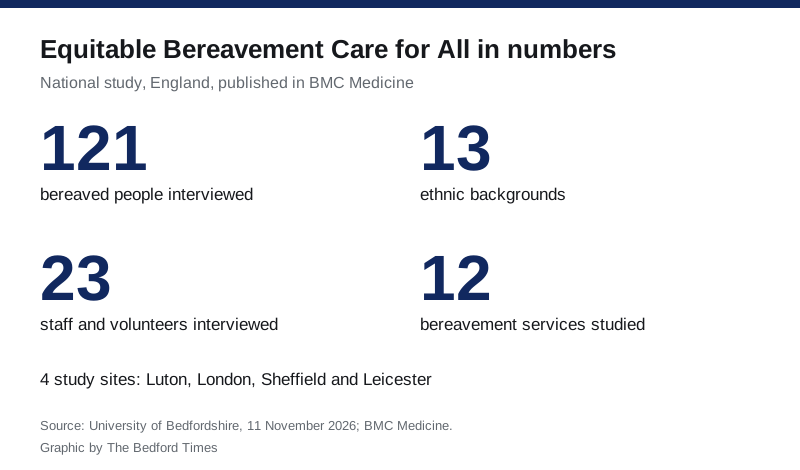
Professor Gurch Randhawa, Director of the university’s Institute for Health and Wellbeing Research, was a co-applicant on the project. The university led the fieldwork in Luton, one of four places studied alongside London, Sheffield and Leicester.
What the researchers did
Researchers spoke to 121 bereaved people from 13 ethnic backgrounds across England. They interviewed 23 staff and volunteers from 12 bereavement services, then worked with bereaved people, service providers and others to draw up recommendations.
According to the paper, the interviews with bereaved people and services took place between January and October 2024, and the workshops that shaped the recommendations ran from March to July 2025. Community researchers who spoke several languages recruited participants through community groups and faith and community leaders.
The barriers it found
The study lists the barriers people met when looking for help after a death:
- a lack of culturally appropriate support
- language difficulties
- long waiting lists
- limited diversity among staff
- poor signposting and referral
- a lack of sustained funding for community-led organisations
Experiences and fears of racism also affected whether bereaved people could find, trust and use the services on offer, the researchers found, and some avoided formal support altogether.
Professor Randhawa said: “Bereavement support should be accessible to everyone, regardless of their ethnic or cultural background. Our research highlights that too many people face barriers when seeking support at one of the most difficult times in their lives. Through our work in Luton and nationally, we want to help ensure that services better reflect the needs of the communities they serve, and that nobody is left behind.”
What the study says should change
The recommendations include:
- more investment in community-led bereavement organisations
- care that is culturally informed and anti-racist
- a bereavement workforce that better reflects the communities it serves
- stronger partnerships between mainstream services and community organisations people already trust
It also calls on national and local decision-makers to put equity at the centre of bereavement policy, and to monitor access, experiences and outcomes for different ethnic groups.
What it means for you
If you have lost someone and could not find support that fitted your family, faith or language, the study says the fault lay with the system, not with you. Its recommendations are aimed at the NHS, councils, commissioners and the charities that run bereavement services, including those serving Bedford borough and Luton.
Who ran the study
The study was led by Dr Catriona Mayland at the University of Sheffield and Dr Sabrina Bajwah at King’s College London, with universities and community organisations across the UK. It was funded by the National Institute for Health and Care Research (NIHR) Policy Research Programme. This paper was led by Professor Lucy Selman of the University of Bristol.
The full paper, How to tackle inequities in bereavement support for ethnically diverse communities, is free to read in BMC Medicine.
Have your say