
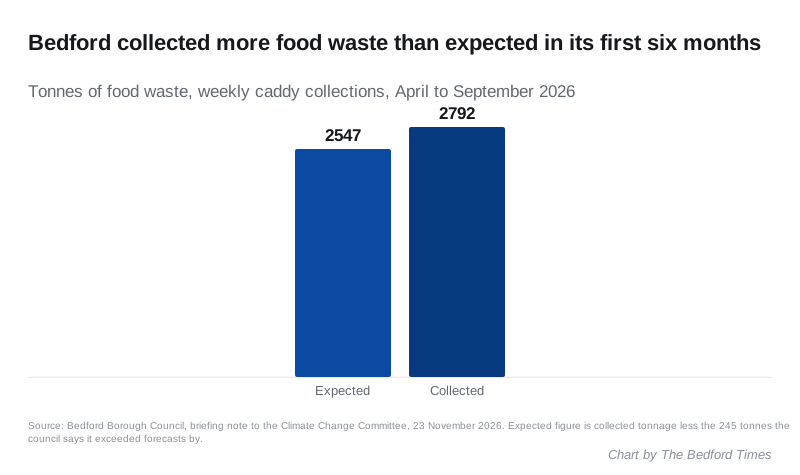
Bedford's weekly food waste service collected 2,792 tonnes in six months, 245 more than forecast. The council also logged 4,434 missed caddy reports.
Bedford households put 2,792 tonnes of food waste in their caddies in the first six months of weekly collections. That is more than 245 tonnes above what the council expected.
The figures are in a briefing note for Bedford Borough Council’s Climate Change Committee, which meets on Monday 23 November. They cover April to September 2026.
Weekly food waste collections began on 30 March 2026 for every household in the borough, including flats.
Overview
- Collected: 2,792 tonnes of food waste, April to September.
- Forecast: about 5,094 tonnes a year, based on other councils’ experience.
- Black bins: about 3,100 tonnes less rubbish than in the same months last year.
- Missed collections: 4,434 reports, under 1% of 1,705,824 scheduled collections.
More than expected
The council’s forecast was based on what other councils had seen. It expected around 5,094 tonnes a year.
The note says tonnage peaked in June and July. It puts that down to good weather and summer sport. It fell in the school holidays but stayed above the expected monthly level.
Black bins collected about 3,100 tonnes less over the same six months than a year earlier. The council is careful about the reason. Glass also moved out of black bins and into orange-lid recycling bins in December 2025, so it says it cannot tell how much of the drop is down to food waste alone.
The food goes to Biogen, the council’s food waste reprocessor. The note says it turns it into renewable energy and fertiliser. Two loads were rejected in six months, both for operational reasons rather than anything residents put in their caddies.
A rough start
The council admits the first few months “did not run as smoothly as we would have liked.” It blames staff and vehicle shortages.
It ordered seven food waste lorries in February 2025, at a total cost of about £1.02 million paid by a government grant. Supply problems across England delayed the last three. The supplier lent stand-in vehicles at its own cost until the last lorry arrived in July.
Residents reported 4,434 missed food waste collections up to the end of September. The council says that is less than 1% of the 1,705,824 collections scheduled, about the same rate as its other bin services. It says the service had “bedded in” by the end of the summer.
How big the round is
- seven routes cover about 71,000 addresses a week
- more than 284,000 collections are made each month
- about 60,000 caddies were delivered between January and March 2026
- more than 670 blocks of flats share communal food waste bins
- 13 public food waste units, mostly in the town centre, serve flats with no outside space
About a fifth of the borough’s homes are flats. The note says recycling in flats and shared housing is “of particular concern” because so few residents in them take part.
What happens next
The council plans two studies:
- a check of what is still going into black bins, in 2027
- a doorstep survey of who uses their recycling bins, to find the areas where few people do
The note says the extra lorries will also cost more to run. It expects repairs of about £30,000 to £40,000 a year at first, rising to £50,000 to £60,000. It is not yet clear how government money for this will reach the budget.
What it means for you
Nothing changes to your collections. Food caddies still go out every week on your usual bin collection day.
The 4,434 figure counts missed caddies that residents reported to the council, so a collection missed but never reported is not in it.
Have your say