
Defra puts Bedford at 36.8% for 2024/25, behind every neighbour but Luton. The council says 11,774 tonnes were recycled before food waste collections began.
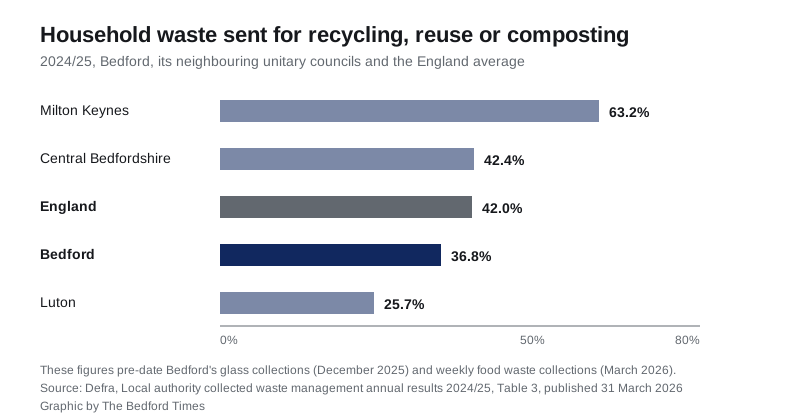
Bedford Borough Council thanked residents last week for recycling 11,774 tonnes of household waste in the year to the end of March 2026. The official national figures tell a harder story. Bedford recycles a smaller share of its household waste than England as a whole, and a smaller share than every neighbouring council except Luton.
Defra’s most recent full-year figures, for 2024/25, put Bedford’s household recycling rate at 36.8 per cent. The England figure is 42 per cent. Among the 97 unitary authorities in England, Bedford ranks 58th. Within the eastern region it is 42nd out of 48 councils.
The gap shows up in black bins too. In 2024/25 the average Bedford household threw away 593.2kg of waste that was not recycled. The England average was 513.3kg. That is roughly 80kg more per household, every year. (Defra, local authority collected waste management annual results, published 31 March 2026)
The 11,774 tonnes is not the same measure
The council’s figure and Defra’s are not comparable, and it is worth being clear why.
Defra recorded Bedford as sending 27,933 tonnes of household waste for recycling, reuse or composting in 2024/25, out of 75,875 tonnes collected in total. That total includes garden waste and the tip. The council’s 11,774 tonnes covers a different, smaller slice, and its announcement does not say which collections are counted.
So treat 11,774 tonnes as the council’s own measure of its own kerbside performance, not as the borough’s recycling total. (Bedford Borough Council, 13 August 2026)
Why next year’s figure is the one that matters
Bedford’s recycling rate has been falling for most of a decade. It peaked at 44.5 per cent in 2017/18, dropped to 35.7 per cent in 2022/23, recovered to 38 per cent in 2023/24 and slipped again to 36.8 per cent in 2024/25.
Two changes since then have not yet reached the official statistics:
- glass bottles and jars went into orange-lidded household recycling bins from 1 December 2025
- weekly food waste collections began at the end of March 2026, right at the close of the 2024/25 reporting period and beyond it
Both land squarely in the 2025/26 and 2026/27 Defra figures, not the ones published so far. Food waste is the bigger lever of the two, because it is heavy and because it currently sits in black bins that are counted as residual waste.
The council’s early numbers suggest it is working. More than 1,900 tonnes of food waste were diverted from black bins in the service’s first four months. The average collected on each collection day rose from 20.11 tonnes in April to 21.90 tonnes in May and 23.47 tonnes in June, then held at 22.17 tonnes in July.
The council also acknowledged that the rollout has been rough. Its statement names heatwaves, staff shortages and crews adapting to new rounds as reasons collections have not always run smoothly, and thanks residents for their patience.
What it means for you
If you have not started using the weekly food waste bin, that is the single change that moves both the borough’s rate and your own black bin. The council’s guidance is specific, and two points are commonly got wrong:
- do not put the kitchen caddy itself inside the outdoor food waste bin; tip the contents in and present the outdoor bin
- put the outdoor food waste bin out in the same place as your other bins, every week
On maggots, which is a live problem in August, the council’s advice is to leave uncovered food out for as short a time as possible. It also passes on two suggestions from residents: double-bag food in hot weather, and sprinkle a little salt over food waste to cut the moisture. The outdoor bins are designed to be easier to clean than a black bin.
Glass bottles and jars now go in the orange-lidded recycling bin rather than to a bottle bank. That has been the case since 1 December 2025 and is still the change residents ask about most.
The council publishes further guidance at bedford.gov.uk/ReduceWaste. Our local information pages cover the other practical Bedford questions, from house prices to roadworks.
None of this is only about the environment. Waste that is not recycled costs the council more to dispose of, and disposal costs sit inside the same budget as everything else the borough pays for.
Sources
- Nearly 12,000 tonnes recycled as Bedford Borough residents make a difference, Bedford Borough Council, 13 August 2026
- Bedford Borough marks third month of weekly food waste collections, Bedford Borough Council, 21 July 2026
- Local authority collected waste management annual results 2024/25, Defra, published 31 March 2026, Tables 1 and 3
Have your say