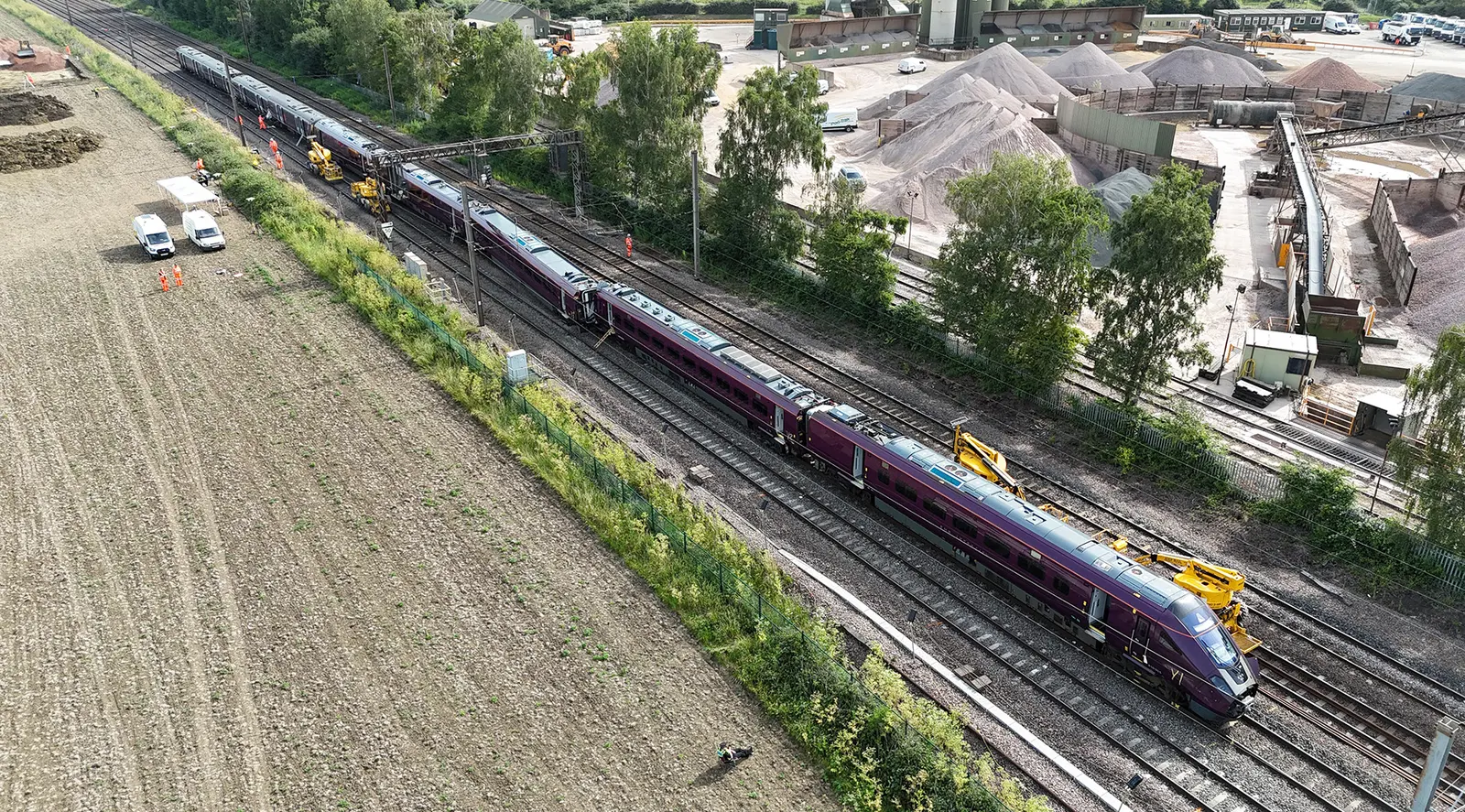

RAIB's interim report on the Elstow crash: the Corby train passed signal WH154 at red, which had no TPWS. A faulty AWS warning had stopped the train ahead.
The train that crashed into another near Elstow in June passed a red signal at about 58 mph and was still accelerating. That signal had no Train Protection and Warning System (TPWS) equipment, the device that would have braked the train automatically when it passed a red. The law did not require it there.
The findings are in an interim report published on 1 October by the Rail Accident Investigation Branch (RAIB). It is the first detailed account of the collision on the Midland Main Line, about 2.5 miles south of Bedford station, at around 17:13 on Friday 19 June.
The driver of the Corby train died in the collision. RAIB has so far identified 257 people on board the two trains. At least 160 were injured and 102 were taken to hospital.
RAIB says the reasons the train passed the signal at danger are still under investigation. It does not apportion blame, and its report says it should not be used to.
What happened, according to RAIB
Two East Midlands Railway (EMR) services were involved, both heading for London St Pancras:
- 1H46, the 16:40 from Corby, a four-car class 360 electric train with 157 people on board, including the driver and the guard
- 1B67, the 15:50 from Nottingham, a five-car class 810 bi-mode train with 100 people on board, including eight EMR staff
The Nottingham train was running 18 minutes late when it passed nonstop through Bedford on the fast line at 17:09. Its driver was already qualified and was training on the new class 810, with a driver-instructor in the cab. EMR began bringing class 810s onto its intercity routes in December 2025.
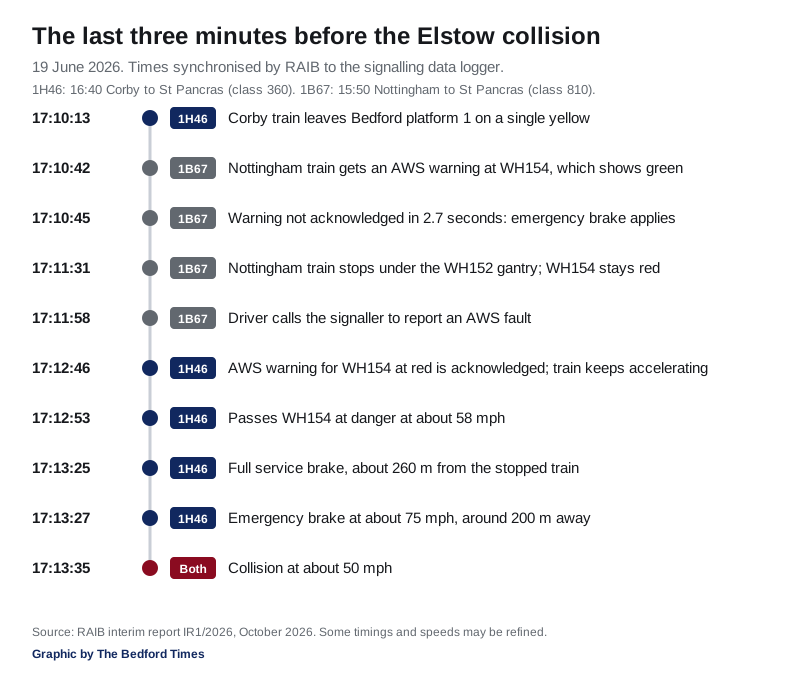
As it passed signal WH154, just south of Bedford South Junction, the train got an Automatic Warning System (AWS) warning. The signal was green. A green signal should give a bell, which needs no response. A warning horn means any other aspect, and the driver has 2.7 seconds to acknowledge it before the emergency brake applies.
The warning was not acknowledged. The brakes came on and the train stopped at 17:11:31 under the gantry for the next signal, WH152. Signal WH154 behind it then stayed at red to protect it.
The driver reported an AWS fault to the signaller. RAIB says the recording of that call has a loud alarm sounding in the background. Hitachi, which built the class 810, confirmed it was the AWS warning, played through a loudspeaker above the driver’s head. Neither the driver nor the instructor recognised the sound, according to witness evidence, and the button that would have silenced it was not pressed.
Meanwhile the Corby train had left Bedford platform 1 at 17:10:13 on a single yellow. That aspect tells a driver to be ready to stop at the next signal. RAIB says the driver controlled the train’s speed out of Bedford and promptly acknowledged the AWS warning at the junction signal, which was also showing a single yellow. The train crossed onto the fast line.
At 17:12:46 it got the AWS warning for WH154, which forward-facing CCTV shows was at red. The driver acknowledged it, but the train kept accelerating and passed the signal at 17:12:53. It reached a top speed of 76 mph.
The track curves right on that stretch. The last CCTV frame from the Corby train, about 600 metres short of the stopped train, shows it ahead but not whether it is on the same line. RAIB says a driver may have had the same limitation.
The driver applied the full service brake about 260 metres from the stopped train, around 10 seconds before the impact. The emergency brake followed two seconds later, at about 75 mph. The collision came at about 17:13:35, at around 50 mph.
Why there was no automatic brake at the signal
TPWS was fitted across Britain’s main lines after the Southall and Ladbroke Grove crashes in 1997 and 1999. At a signal, it puts a pair of loops between the rails that trip a train’s brakes if it passes at red.
RAIB found that signal WH154 had no TPWS track equipment. The Railway Safety Regulations 1999 exempt places where passing a red could only cause a train to run into the back of another going the same way on the same line. Network Rail can still fit TPWS at such signals if it judges the risk high enough.
It had not judged WH154 that way. The key points from the report:
- Network Rail last risk-assessed WH154 on 29 October 2025 and scored it as a low SPAD (signal passed at danger) risk.
- Its score was 3.844 x 10⁻⁷ “fatalities and weighted injuries” a year. A signal needs more than 3.000 x 10⁻⁵ to go through the more detailed assessment that can lead to TPWS being fitted. That is about 78 times higher.
- The Rail Safety and Standards Board has no record of any train passing WH154 at red since its records began in 1985.
- But a red at WH154 is rare. RSSB analysis found that no train had met it at red at all in 2026 before the crash.
- WH154 has no SPAD alarm in the West Hampstead signal box, which controls the Bedford area. The signallers there cannot see what aspect automatic signals like WH154 are showing.
Fitting TPWS at a plain-line automatic signal is normally driven by something like a station, which makes a stopped train ahead more likely. Here, the train ahead had stopped because of a false warning.
The faulty warning that stopped the Nottingham train
Network Rail tested the signalling after the crash, supervised by RAIB, and found no faults.
Then, on 9 July, another class 810 approaching WH154 got the same wrong AWS warning while the signal showed green. That driver acknowledged it within 2.7 seconds, reported it at once, and carried on.
Investigators then found that the AWS electromagnet at WH154 sat 16 mm below the top of the rail. The allowed tolerance is plus or minus 12 mm, so it was 4 mm out. It was also lower than the permanent magnet beside it. RAIB says it has found no evidence that the electromagnet was not correctly energised. It is still working out how the magnet and the class 810’s equipment combined to give a warning on a green.
The report also notes that the class 810 cab has an “enhanced” TPWS panel, laid out differently from the standard panel on trains the driver of 1B67 knew better. On the standard panel, a flashing yellow button means a TPWS fault. On the enhanced panel, it means the brakes came on because an AWS warning went unanswered.
The response
The signaller at West Hampstead first knew something was wrong from a loss of power to the overhead wires near Bedford South Junction. They could not reach either driver.
The report sets out the timings:
- 17:14: Bedfordshire Fire and Rescue Service gets a 999 call from the train
- 17:19: the signaller gets the first report of the crash, from a passenger using a signal post telephone at the WH152 gantry. The Nottingham train’s driver called from the same phone shortly after.
- 17:24: Bedfordshire Police arrive, the first emergency service on scene
- 17:28: Bedfordshire Fire and Rescue Service arrive
- 17:35: East of England Ambulance Service has multiple ambulances on scene, and British Transport Police declare a major incident
Both trains derailed but stayed upright and in line. Their combined length shrank by 9 to 10 metres. The passenger windows on both trains stayed intact.
With power lost and the train derailed, the driver of the Nottingham train and the train manager put track circuit clips on the neighbouring lines. These make the signals behind them show red, so nothing ran into the wreckage. The guard on the Corby train was knocked over in the rear cab. They tried to make an emergency radio call, but the train had no power.
What happens next
RAIB will publish a final report with any safety recommendations when its investigation ends. It has not given a date. Among the things it is still examining:
- why the Corby train passed WH154 at danger, and what influenced the people involved
- how the braking, AWS and other safety systems on the Corby train performed
- why the Nottingham train stopped, and the state, position and visibility of WH154 and its AWS magnet
- how both trains held up in the collision
- the emergency response
- how the risk of a train overrunning at this spot was assessed, and whether the controls were enough
The investigation is separate from those by British Transport Police, the Office of Rail and Road and the rail industry.
What it means for you
If you travel to London from Bedford, every train uses this stretch of the Midland Main Line. RAIB’s report records that Network Rail tested the signalling after the crash and found no faults, and that the misplaced AWS magnet at WH154 came to light after the second false warning on 9 July. The report does not say whether the magnet has since been adjusted.
RAIB says it is still working with British Transport Police and EMR to establish who was on board and how they were hurt. Its enquiries line is 01332 253300, or email enquiries@raib.gov.uk.
For current services and engineering works on the line, see our Bedford to London trains page.
Have your say